

Adventures In Crustaceanity
Three Crustaceans Walk Into a Sand Bar...

If you like what you find here, please tap the ❤️ icon and subscribe. More about me, here.
A little while back, my good friend Peter shared a Threads account he stumbled upon called Church of Crustianity. Their tagline is:
In Cheesus We Crust. Spreading pizza, peace, and antifascism one slice at a time. Grab a slice and join the resistance.
Brilliant!
I was jealous of this pun. Immediately, I went to work. I needed a Christian pun of my own. It wasn’t long before the world of Crustaceanity started to form in the primordial juices of my mind.
Would this world be silly? Would it be serious? (How could it be serious?!) What would be the point? Did there have to be a point? I thought, maybe I could just do a one-off cartoon and then be done with it. No… it was too good.
And so, I imagined Crustaceanity as an opportunity for probing heavy thoughts about Christianity in a lighter, and perhaps less offensive, way…
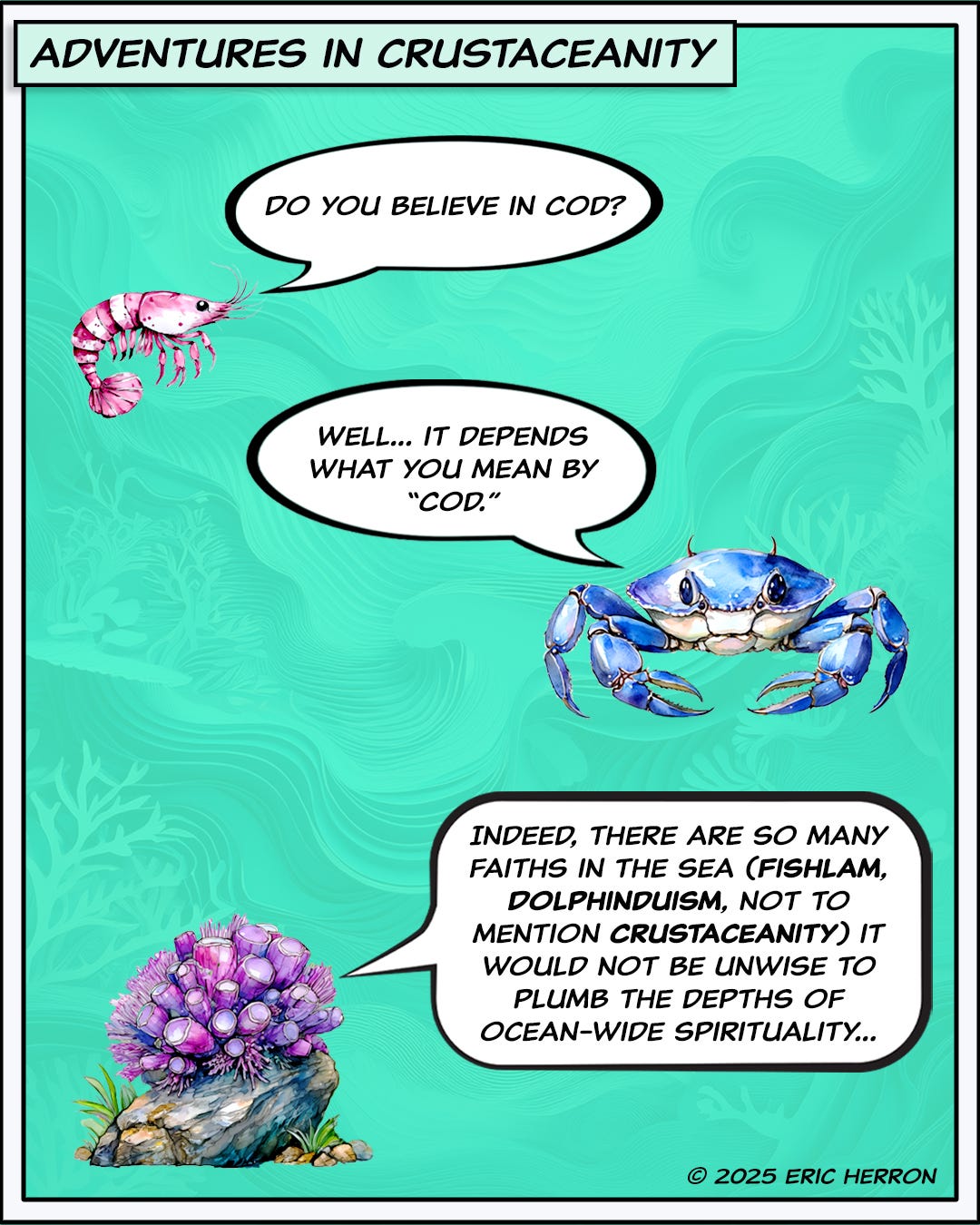
Why might this be a good idea? Artists have used allegory throughout history to broach important topics because imaginary characters and magical settings provide a buffer between disagreeable, even adversarial, conversation partners—especially when the topic is complicated, sensitive, or divisive.
If you can create a little space between the arguers and their arguments, you also create the possibility for openness—even openness to ideas that would otherwise never be entertained.
If you can create a little space between the arguers and their arguments, you also create the possibility for openness—even openness to ideas that would otherwise never be entertained.
Plato explored his beliefs about truth, knowledge and human perception in his Cave Allegory. Swift critiqued the English culture of the early 18th century with Gulliver’s Travels. Orwell expressed his political dismay at authoritarianism in Animal Farm. Whitehead wrote The Underground Railroad to dig deeper (pun intended) into systematic racism…
Am I saying Adventures in Crustaceanity will be crowning literary achievement? Um, no. It’s just a comic. But I do hope to use a cast of crustaceous sea creatures (and their friends) to introduce my thoughts about topics like: the nature of god, heaven & hell, salvation, truth, evil, etc. And since Christianity is deeply embedded in culture, there will be plenty of opportunities for sea-creature satire about politics, social ethics, and many other aspects of world affairs.
Of course, a comic—even a strip with multiple panels—is short. This makes Adventures in Crustaceanity ideal for inviting interaction. I’ll be including Polls and a Chat, inviting readers to interact directly with the topic and each other. My dream is that each comic will spark a lively and respectful conversation where we can all share our unique thoughts, hear different perspectives, and ultimately learn from each other.
Cast of Crustaceans
Now, here’s a little bit about the main characters…
Shrimp: A small Crustacean with a large capacity for curiosity. She knows a lot (almost too much) about the Crustacean faith, having grown up in it. Shrimp might be considered a progressive Crustacean, but on the very fringes of faith. While she isn’t yet ready to throw it all away, she’s been on a journey sorting out which parts of her faith to keep, which parts to change, and which parts need to be completely left behind.
Crabby: A conservative Crustacean who knows exactly what he believes and isn’t afraid to say it. His conviction is strong and his Evangelical Crustacean background informs very particular views about the world. Crabby doesn’t understand why some other Crustaceans feel the need to challenge a faith that works so well for him. With such deep conviction about his truth, Crabby’s mind is not easily changed, even by the most sensible arguments.
The Barnacles: The “Greek chorus” of Crustaceanity. This group of steadfast and tenacious Crustaceans always speaks in unison and brings balance to every conversation. The Barnacles are the voice of Wisdom calling out from the coral reef, filling in the gaps between Shrimp’s questions and Crabby’s answers. Their words have a prophetic tone and come across like the very Word of Cod. Notably, their knowledge stretches across world religions and draws from many different wells of wisdom.
Related Content:

