

Reversing Pascal
God or Not: What's the Best Bet?

If you like this, please tap the ❤️ icon and subscribe. More about me, here.
The fool says in his heart,
“There is no God.”
They are corrupt, their deeds are vile;
there is no one who does good.
2 The Lord looks down from heaven
on all mankind
to see if there are any who understand,
any who seek God.
3 All have turned away, all have become corrupt;
there is no one who does good,
not even one.
Psalm 14:1-3
When I was in high school, I became a bit obsessed with Blaise Pascal. Pascal’s writing contained the confluence of my young heart’s passions: philosophy and theology.
He was also a mathematician, which I admit, was NOT a passion of my young heart, but insomuch as his math skills served his philosophical and theological prowess, I did not mind.
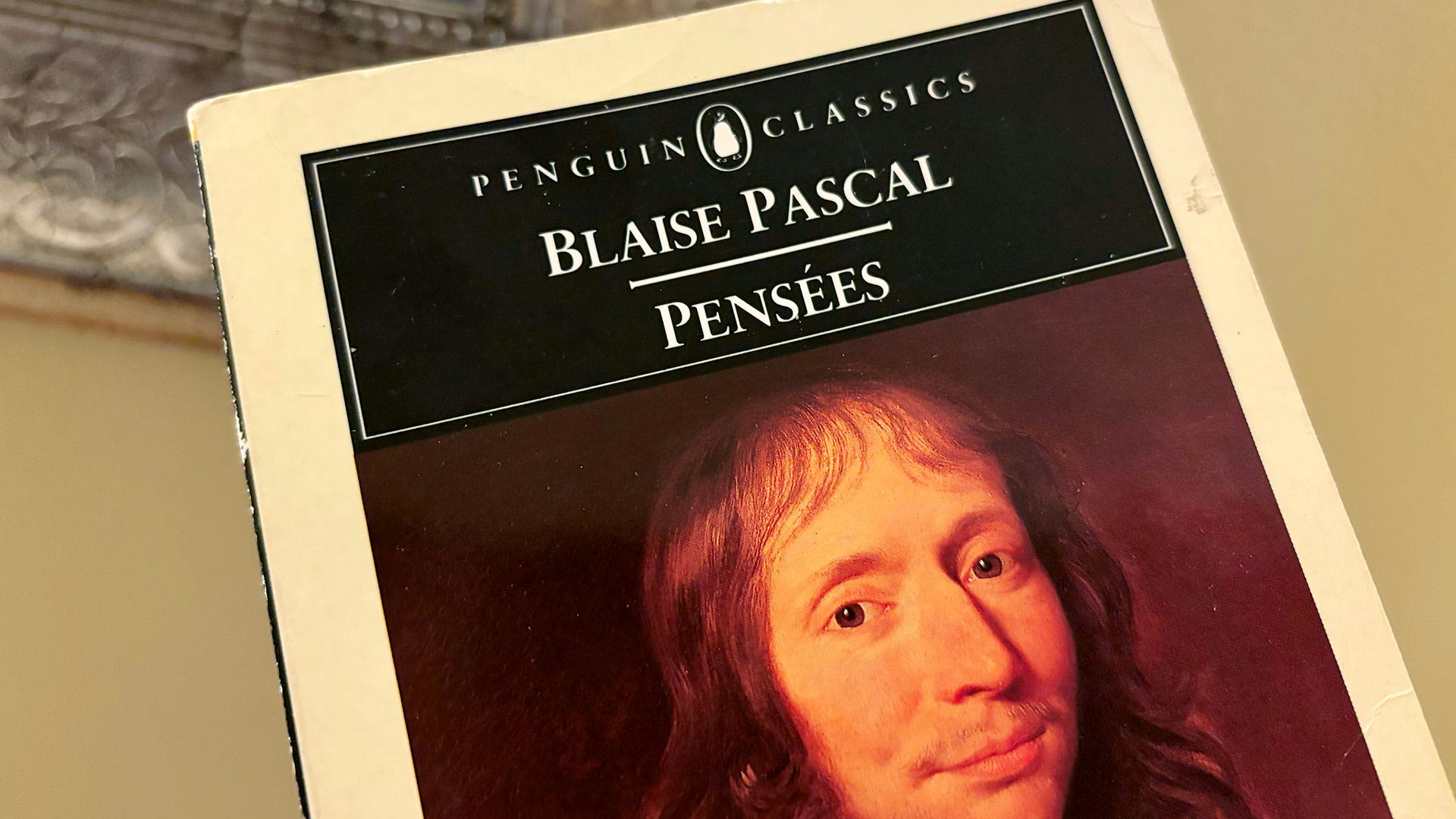
My gateway to Pascal was a worn-out Penguin paperback of Pensées. More specifically, it was that very famous passage often referred to as “The Wager.” Here is a key part (translated from the original French):
“God is, or He is not.” But to which side shall we incline? Reason can decide nothing here. There is an infinite chaos which separated us. A game is being played at the extremity of this infinite distance where heads or tails will turn up… Which will you choose then? Let us see. Since you must choose, let us see which interests you least. You have two things to lose, the true and the good; and two things to stake, your reason and your will, your knowledge and your happiness; and your nature has two things to shun, error and misery. Your reason is no more shocked in choosing one rather than the other, since you must of necessity choose… But your happiness? Let us weigh the gain and the loss in wagering that God is… If you gain, you gain all; if you lose, you lose nothing. Wager, then, without hesitation that He is. [emphasis mine]
§233 of Pensées (1910, Trotter translation)
I asked ChatGPT to simplify Pascal’s Wager, since his 17th century prose is kind of dense. Here’s his Wager in the simplest of terms:
If you believe in God and God exists, you gain everything. If you believe and God does not exist, you lose little. If you do not believe and God exists, you lose everything. Therefore, believing is the better bet.
There is more to Pascal’s so-called Wager, and it is quite complex, containing elements of epistemology, apologetics, and probability theory. If you’re interested in the nitty gritty, I found this Stanford resource to be helpful, if not academically dense.
But here, I don’t want to be academically dense. I’d rather be practical. I fact, I would argue that’s ultimately what Pascal’s Wager boils down to: a practical approach to God’s existence (or non-existence).
“Practical?” you ask, “Doesn’t God just exists, or not?” Yes. Technically, I believe in one reality. And yet, we don’t really know, right? So, I’m wondering if there is any benefit to wagering that God’s does NOT exist. Perhaps there is some present advantage, with a limited downside later on, to actually living as if there is no God.1
I’m wondering if there is any benefit to wagering that God’s does NOT exist.
First, it helps if you don’t believe in hell, more specifically, some kind of eternal punishment for those who don’t assent to certain ideas about the nature of God, or hold to some particular belief system, or perform some kind of rituals (baptism, attending church, etc.) in order to escape it. I don’t believe in hell like that. (I know this opens a can of worms, but it will have to be a discussion for another time.) Suffice it to say that with the belief in hell removed, one need not make their bet about God’s existence based on the fear of forever flames. (In Pascal, I detect a good dose of this fear.)
Without hell to pay, we can now focus on what we might actually lose or gain here-and-now by believing (or not) in God.
Going back to that ancient song from the Bible, I notice that the Psalmist links ‘not believing in God’ very specifically with certain kinds of action:
The fool says in his heart,
“There is no God.”
They are corrupt, their deeds are vile;
there is no one who does good.
This is important. If a key complaint about those who say there is no God is their corrupt and vile deeds, we now have a clear test we can perform to determine whether or not a person is a believer. Ironically, when I observe a majority of believers (at least of the American Christian kind) and put their behavior to this test, many are receiving a failing grade. For example…
I see believers denying factual narratives when it disagrees with their pre-established ideas.
I see believers promoting bad faith interpretations of Bible verses as pretext for political action.
I see believers justifying un-Christlike behavior, like smearing the names of innocent victims of violence.
I see believers equivocating on opposing spiritual values, when Jesus’ way definitively walks on just one side.
I see believers espousing Christianity as it serves their pursuit of power.
I see believers using hateful speech.
I see believers making ethical concessions that enable a neo-nazi agenda.
I see believers downgrading of the seriousness of lies and importance of facts.
I see believers rejecting those who are “other” in the name of Christian Nationalism.
In summary, one might ironically say of believers:
They are corrupt, their deeds are vile;
there is no one who does good.
At the same time, I observe many who do not believe in God, at least in the Christian sense (atheists, agnostics, spiritual drifters, non-specific religious types, etc.), who are consistently working out kingdom-of-god-like actions in the world, doing things that believers in God are supposed to do. For example…
I see unbelievers expressing empathy for the poor & homeless.
I see unbelievers fighting for equal rights for marginalized groups.
I see unbelievers concerned with wars waged elsewhere that endanger the innocent.
I see unbelievers putting godly principles before personal gain.
I see unbelievers seeking fairness & justice, not only in their own lives, but also in the lives of others.
I see unbelievers looking for answers that are beyond platitudes (and Bible verses) and that yield tangible, beautiful, and good results in the world around them.
I see unbelievers who are not concerned with the afterlife, but rather, who just want to find a way to survive and thrive with others in the world, today.
I see unbelievers who enjoy the world in all its beauty and in all the pleasures it has to offer—especially the true and good pleasures provided by nature and positive human relationships.
The Logical Problem
My observations comparing present-day believers with unbelievers presents a logical problem, if we are to take the Biblical text seriously. It appears that in our times, fools are not the ones who say “there is NO God,” as Psalm 14 would suggest. Broadly speaking, the real fools, judging by the Psalmist’s standard of ‘doing good,’ are actually the ones who say that God exists! It is the believers whose deeds are vile and corrupt.
The real fools, judging by the Psalmist’s standard of ‘doing good,’ are actually the ones who say that God exists!
Meanwhile, the so-called “ungodly,” who do not believe in God, seem to more often be acting in the world with love, kindness, goodness, gentleness… all those traits formerly associated with faithful, church-going, Bible-toting, Spirit-filled believers.
What’s going on here? Let’s look a little deeper, below the surface. My theory is that the average 21st century Christian believer-in-God has at least three theological obsessions, which ultimately get in the way of godly behavior—and in many cases, lead to those vile deeds and corruption:
Believers are obsessed with the Bible as a very specific, if not literal, guide for action in the world.2
Believers are obsessed with salvation, which means eternal life after death in a blissful place.
Believers are obsessed with damnation, which means life after death in a place of eternal punishment.
These three theological obsessions play out, over and over again, in what could often be categorized as ungodly ways. Here are just a few specific examples:
Because of Heaven, believers in God lack empathy. Many civilians, especially children, have died in recent conflicts around the world. One instance is the Shajareh Tayyebeh girls’ school in Minab, Iran, which was apparently bombed by the United States, resulting in 156 total deaths, including 110 school children. The response to this from the average Christian is tepid, at best.
Responses I’ve heard from believers range from ignorance (not paying attention) to shrugs, offered in acknowledgement of the sad cost of war. How do we account for this almost non-response? Aren’t Christians supposed to be the most compassionate people on the planet?
It’s because of Heaven. The belief that after this life exists an eternal period of unrestricted bliss is precisely what allows believers to so quickly and callously shrug off such atrocities. Instead of being horrified by the death of innocent children, there is a passive justification of such evil, enacted by the complicity of silence. Those who should be known by their love are instead practicing to be renowned by their nonchalance as it specifically relates to the unspeakable injustice of the death of innocent children.Because of Israel, believers justify unfair treatment of Palestinians. One reading of the Old Testament that is popular among believers in God is a narrative that gives Israel a favored position before God. This is especially problematic when the modern nation of Israel is equated with the ancient people called “Israel.” But it’s also problematic simply in the odd assertion that the God of all Creation favors one group over others, based on ethnicity. Stepping back, one could actually read this as some kind of racism. Of course, the deep irony is that Jewish people have been the victims of ethnic oppression of the worst kind all throughout history. Still, the idea that Israel is superior is embedded in common readings of the Bible. This has the unfortunate effect of subjugating other groups in the minds of believers, most notably those of Palestinian descent.
Talk to a modern Christian and you’ll find that most are adamantly anti-Palestine and pro-Israel—not only when it seems justified, as with the October 7th attacks in 2023, but also, incredibly, while Israel engages in ongoing ethnic cleansing, right before our very eyes.Because of the Bible, abortion overshadows all other injustices. Psalm 139:13 and following is a foundational passage for pro-life proponents. The idea put forth in that ancient poem is that each person was intimately known by their Creator, even before we were born. This is a beautiful sentiment and there’s nothing wrong with it. It very well may be true. However, because of the modern Christian’s view of Scripture, the beautiful idea in that poem has become a rallying cry for conservative political activists who use it as the final word on abortion.
Abortion is complicated, not only because it involves two lives (mother and child), but also because science can’t now, and may never, be able to provide clarity on when dividing cells become a “person.” And while abortion should be rare (in my view), it should by no means be the supreme issue of our times for Christians or anyone—not when there are so many other injustices championed by Jesus himself that are left ignored.
Slavehood to Scripture allows for this ignorance that exchanges reason and experience for uninformed interpretations of the Bible that equate poetry with science. Generally speaking, the very nature of the Bible (as a collection of varied genres with different authors from different times and places) promotes unbalanced interpretation from generation to generation and from culture to culture.
If we remove one’s belief in the Bible, it opens up the opportunity for more dialogue surrounding complicated issues like abortion. When the “Word of God” is heard as one of many wise voices in our world, meaningful dialogue can be had—and the potential for dogmatic, myopic, and harmful views is minimized.
Now, Psalm 14 continues in verse 4, questioning the actions of the ones it labels as unbelieving fools:
Do all these evildoers know nothing?
They devour my people as though eating bread;
they never call on the Lord.
5 But there they are, overwhelmed with dread,
for God is present in the company of the righteous.
6 You evildoers frustrate the plans of the poor,
but the Lord is their refuge.
Psalm 14:4-6
Verse five presents more cognitive dissonance for us when it proclaims that “God is presents in the company of the righteous.” Could it be that things have flipped? Could it be that the primary “evildoers” are believers, while God is enjoying the company of the unbelieving righteous ones? Could it be that the real fools are the ones who say there IS a God?
Could it be that the primary “evildoers” are believers, while God is enjoying the company of the unbelieving righteous ones?
Reversing Pascal
If you were to remove hell from the equation (a theological action for which numerous reasonable and persuasive arguments have been put forth by respected Christian theologians), Pascal’s original Wager ends up being much less lucrative. In fact, there is conceivably more to lose by believing in God—regardless of what ends up being true.
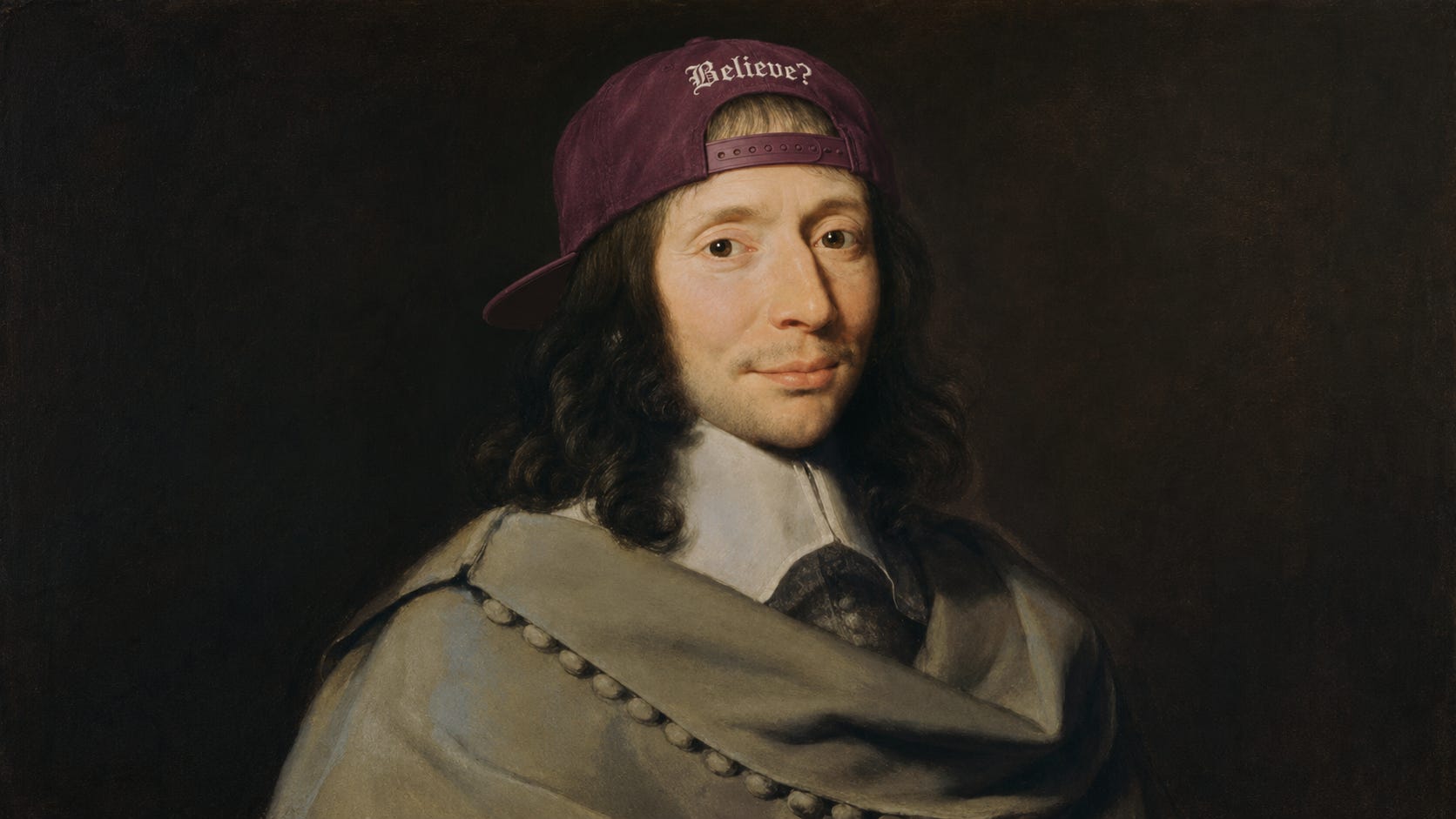
What I mean is, if you wager that God does exist, you will likely end up behaving as many modern Christians do. That is to say, you will live a narrow life, with a constant undergirding murmur of fear. You will fail to appreciate the human body. You will be too shy about sex to really understand what the fuss is all about. You will miss beauty, real deep beauty, because you are afraid of thinking or seeing something that might offend the invisible God.
You will be incorrigibly judgmental. Grace and mercy will trickle from one corner of your mouth, as condemnation and hatred spout out of the other like a five-alarm fire hose.
Perhaps the saddest part about your life, if you believe that God exists, will be the real tendency to take for granted the ones you love. You will say you love them—and mean it, for sure. The problem is, with eternal heaven sprawling out before you, you will believe you have all the time in the world (and all the time in the next) to love your daughter, cherish your spouse, be a beloved friend, etc.
The extended timelime provided by a belief in eternity significantly reduces the urgency and intensity that true love requires. As a result, your love may be reduced to a limp, lagging affection that tells itself, “I can love tomorrow, and it will be just fine. I have an infinite future to love my daughter, cherish my spouse, and be a beloved friend.” (Though, if you believe in God, you will likely also hold to that popular idea that there is no marriage in heaven, so… maybe you’ll feel compelled to love your wife now. Or maybe not.)
On the other hand, if you suspend your belief in God (and with it, belief in any kind of afterlife, at all), you will naturally have the motivation to live a life that is full, vibrant, and daring. When a real, impending terminus is perceived in your future, you will inherit the impetus to become fully alive in all your humanity. Believing that your existence is only finite leads to all sorts of positive urgencies—to love, to share, to express emotion, to be authentic—even when it’s risky.
When one wagers that God does not exist, the most urgent motivation would be to tend to one’s close relationships. If I believe that when I die there is nothing and complete nothingness, I will either despair (I acknowledge this is a real possibility), or more likely, I will look upon each and every moment with my parents, wife, sons, daughter, close friends… as the most precious of all things. This is because I believe that once I am gone (or they are gone), then I (or they) will be really gone.
If my reverse Pascal wager that God does not exist and there is no afterlife is true, then I have gained a bountiful and beautiful (albeit finite) human life, lived to its fullest potential.
In the case that my reverse Pascal wager turns out to be false (in other words, if there does turn out to be a God), I will still be on the positive side of the bet, since God, who is LOVE, will recognize that God’s Creation (you and me) have explored the depths of humanity and embraced the Imago Dei, and therefore will be welcomed into the presence of God with open arms.
… Of course, if hell is real (and exists as the conservative Christian believes), then Pascal’s original Wager wins the day.
Disclaimer: I don’t mean to wholeheartedly assert that there is no God. Personally, I do believe in a God, although, I’m uncertain of God’s specific nature. This discussion suggesting we might reverse Pascal’s Wager is really just a theological thought-experiment. But it is a serious one, especially as it relates to the real conflict I’ve uncovered between the actions of believers and their profession of faith. So… just hang with me and let’s see where it goes!
I am aware that I am criticizing adherence to Scripture, while also using several Bible verses in the Psalms as the crux of my argument. I want to allow this tension, especially for the believer who needs to find coherence in the text. For me, it comes down to proper exegetical (interpretive) methods applied to the verses at hand.