

Ghee Christ
Clarifying Atonement Theology

I didn’t learn of Andres Serrano’s “Piss Christ” until Barry Taylor’s modern art class at Fuller Seminary around 2006. If I had known about the photograph when it was created in 1987, I surely would have protested—just as my young Evangelical friends and I did with “The Last Temptation of Christ,” which came out around the same time. (We even wrote a scathing rebuke of the film for a newsletter—despite the fact that we had never watched it.)
But by the 2000s, I was much more open minded and I found Serrano’s work to be inspiring, both artistically and spiritually.
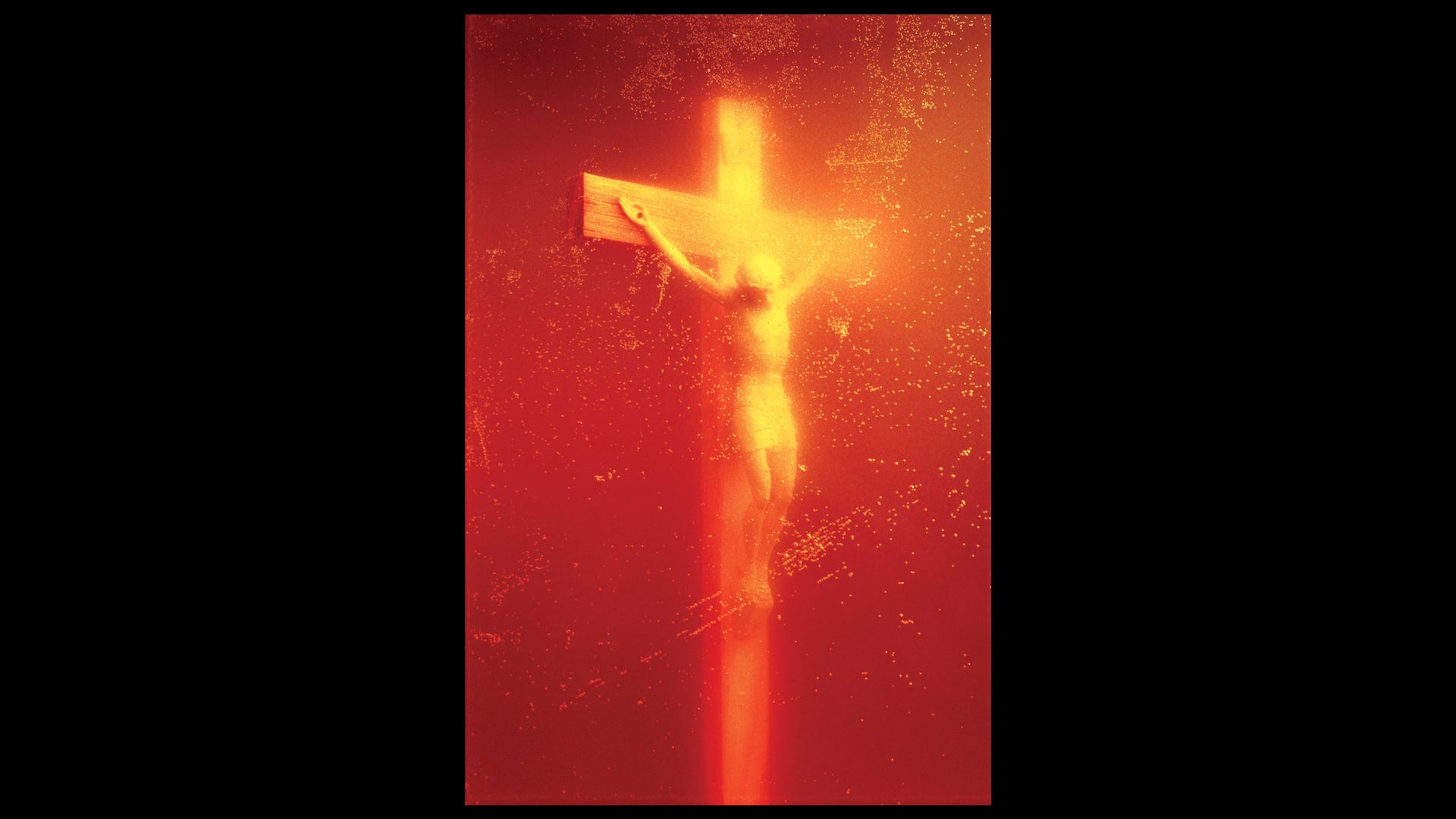
“Piss Christ” is genius to me for a few reasons.
First, it is beautiful. If you don’t know that the crucifix is submerged in the artist’s urine, you’d think it’s amber or some other magical liquid. It is yellow, yes; but also red. And orange. And brown. And the way it’s lit from the front and above suggests Someone is looking down on the scene. The tiny bubbles form interesting, unpredictable patterns as they catch and reflect the light.
Second, Serrano allows it to speak. He didn’t put much effort into explaining it. He wants viewers to react however they will, without any prompting—other than the image itself.
Third, “Piss Christ” challenges our ideas of the crucifixion. It does this by taking a well known religious object and placing it somewhere it doesn’t belong. This raises questions and leads to new ways of thinking.
Whenever we are confronted with art that challenges our held beliefs, it can cause us to repent (literally rethink our thinking). “Piss Christ,” has the capacity to inspire novel ways of contemplating the crucifixion—and I wouldn’t be surprised if that was one of Serrano’s hopes from the start.
Incidentally, Serrano grew up in Brooklyn, went through confirmation class as a child, and remains a “follower of Christ” to this very day. His work comes from a distinctly Christian perspective. Watch this video to hear it from the artist himself.
So… when I was assigned Station Eleven: “Jesus Is Nailed to the Cross” for an interactive Good Friday event in 2015, one of my first thoughts was to submerge a crucifix in something. Naturally, I thought of butter.
As I’ve mentioned elsewhere, my day job is writing about food. I think that around that time I had just discovered ghee, which is essentially clarified butter. I imagined melting a whole bunch of butter, then simmering it until the milk solids separated and I could skim them off, leaving the clarified milk-fat. I followed this process and it did yield a clear yellow liquid.
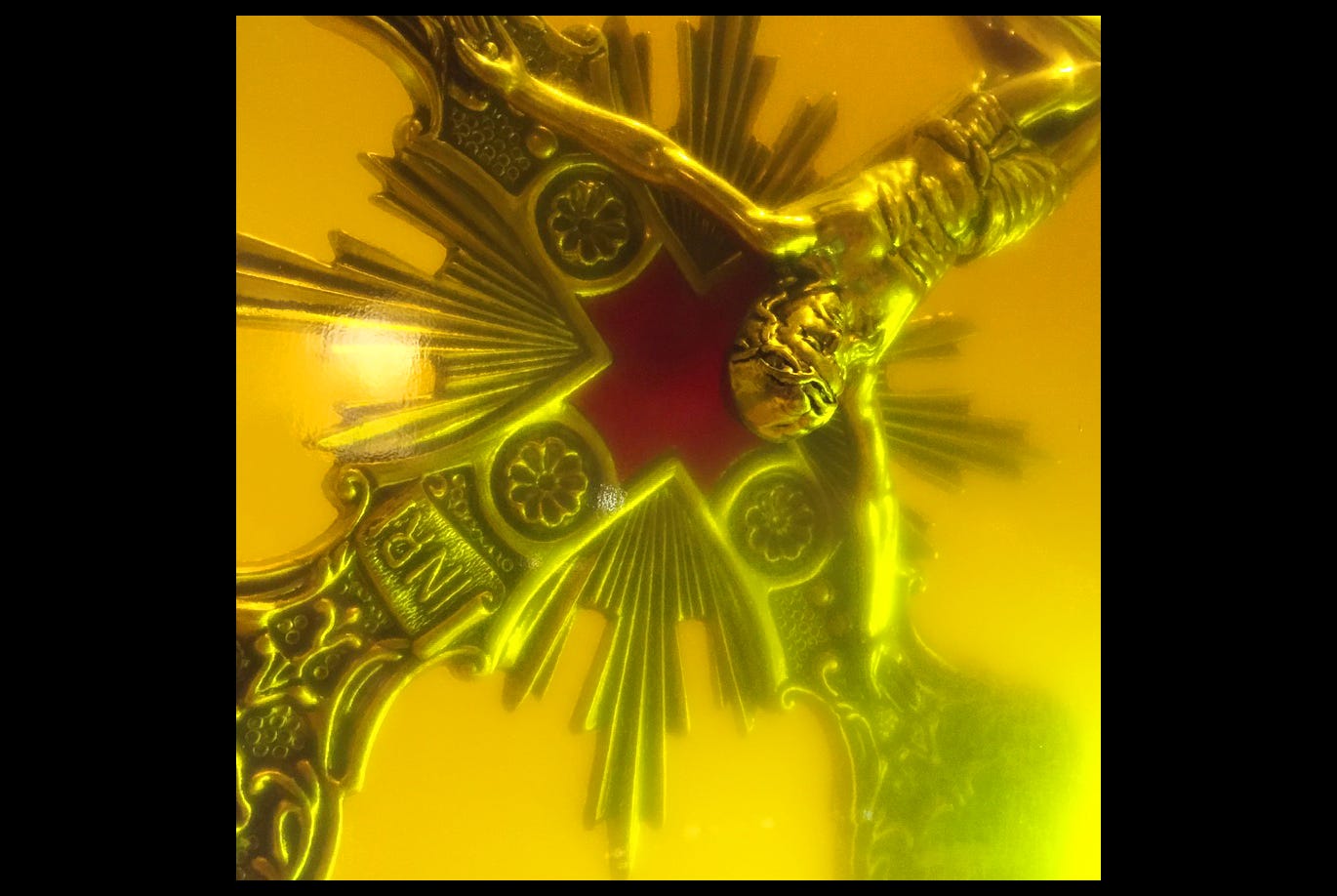
As for the crucifix, I made a trip down to the Mexican marketplace at Olvera Street (the birthplace of Los Angeles) to treasure hunt for just the right one. I think it cost around $25 and was just what I was looking for—ornate and detailed, with a realistic-looking Christ figure and touch of solid red behind his head and torso to accent the brushed silver and gold metal.
It was a bit harder finding a glass cube that was large enough to fit the crucifix, but after visiting some local flower shops, I found the one. The carpentry nails came from a nearby hardware store.

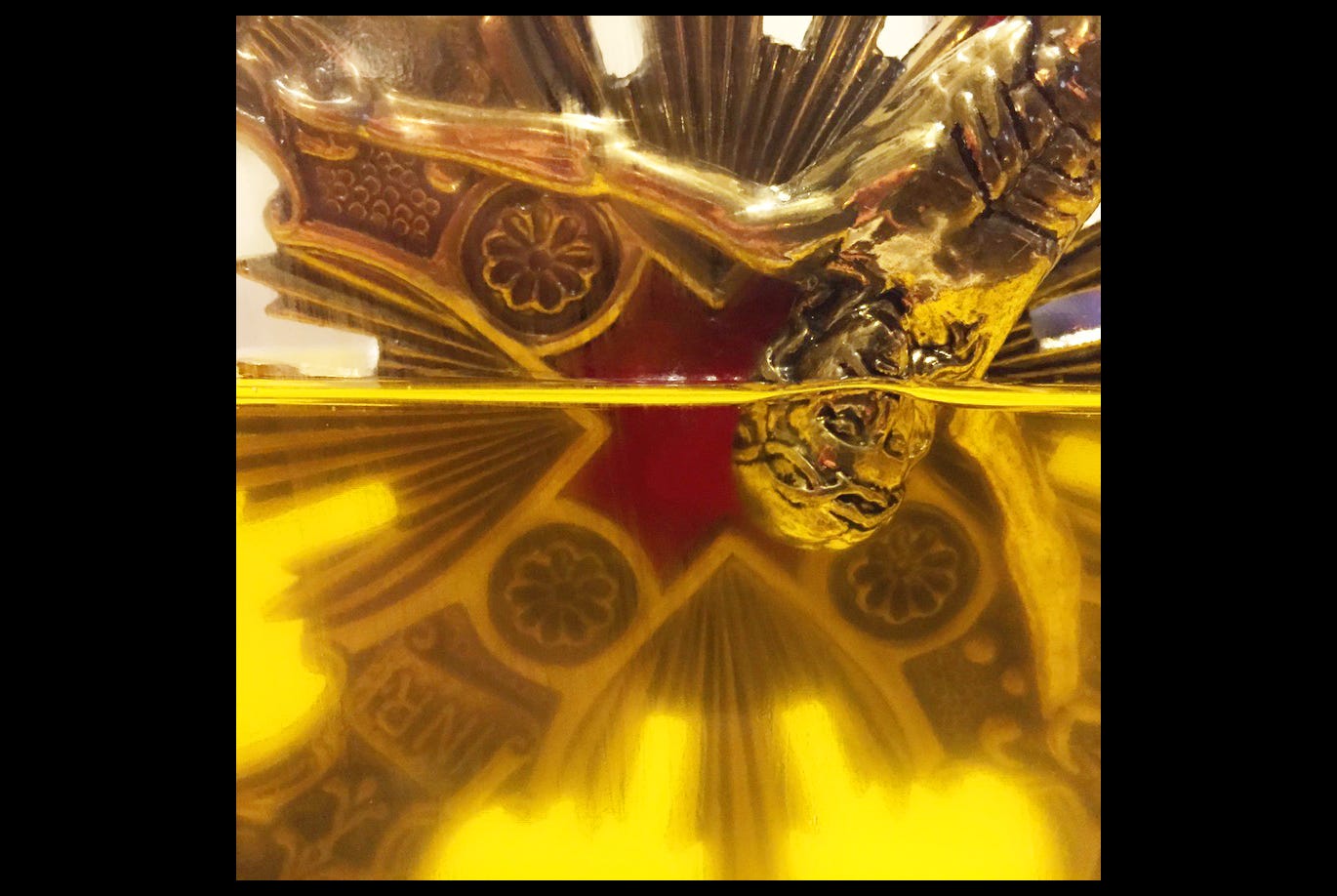
One thing I didn’t account for was the effect of fluctuating temperature on the butter. Warm ghee is definitely transparent, but as it cools, even just to room temperature, the milk-fat begins to solidify again and ultimately becomes opaque. The result is a substance reminiscent of candle wax.
For my interactive display piece, I ended up with the crucifix only about one-third submerged in the thick butter. Instead of cleaning the oily residue from the cross, I allowed it to remain, and it turned white and clumpy as it cooled, creating an eerie effect, which I illuminated with a single tea-light candle.

Both effects were stunning and I began to think about what a crucifix submerged in clarified butter might be “saying” about idea of Jesus being nailed to a cross. I wondered, “What is the theology here?”
Theological Fat
“Ghee Christ” started me thinking about the culture in which we are submerged and in which Christ is submerged with us. It’s a culture of fat, with excesses that extend beyond wealth and want, capitalism and consumerism. This culture of fat can be found even in the Church. Christians are submerged in it with Christ.
But Christians have also been baptized in theological excess.
The ‘theological fat’ that hangs on the cross along with Jesus includes the myriad theories by which believers through the ages have attempted to explain what is going on behind the scenes, in the spiritual realm.
An oily build up of dogmatic blubber weighs down an already heavy cross. And like room temperature ghee, this theological fat becomes opaque, obscuring the very person who was the inspiration for the fat-fest to begin with.
Atonement and Lattés
There are at least seven common theories of atonement that have developed since the historical Cross event. These theories overlap, repeat, reinterpret, and build upon one another. Despite their differences, each theory is an attempt to sort out the same question: How does the death of Jesus fix the problem of sin in the world?
I have an old memory of sitting in a gymnasium with a hundred or so Baptist students and listening Dawson McAllister describe atonement as “at one ment”—it’s how Jesus’ death reconciles us, or makes us ‘one’ with god. That’s a clever mnemonic device, but I’m not sure this early pioneer of the Evangelical youth movement would appreciate the clevernesss of Ghee Christ.
The more that theories of atonement speculate about the invisible, supernatural work of god, the more wild they become. In contrast, theories of atonement that opt for a simpler explanation—one based solely on an account of the physical events and narrative—tend to be more appealing to me. These narrower theories also tend to be more practical.
Below I briefly describe the main theories of atonement and rate them on my very scientific milkfat scale. (TAP graphic to ENLARGE.)
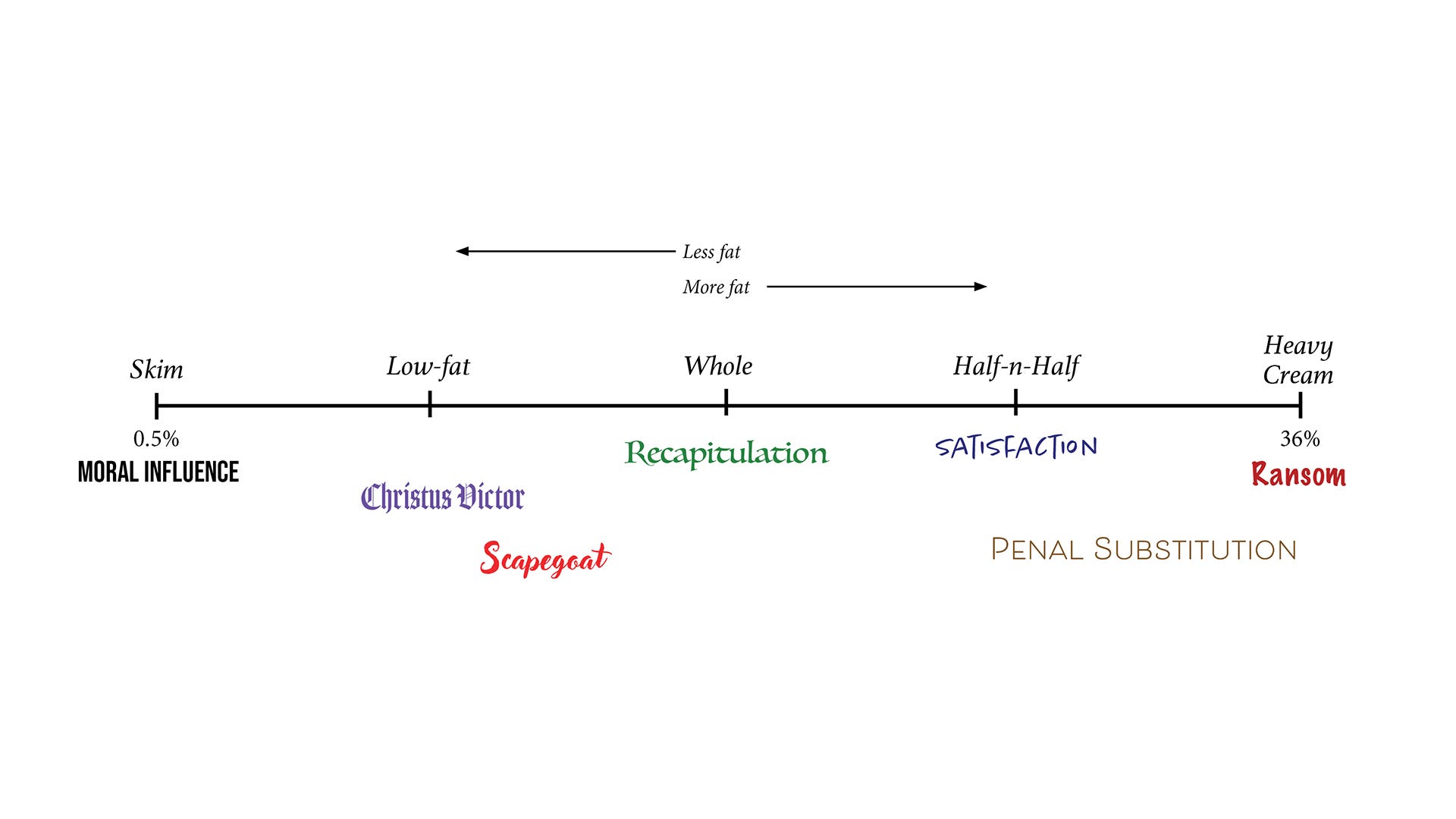
MORAL INFLUENCE [Skim]: The death (and life and resurrection) of Jesus are events that inspire reform of human society and culture by example.
I like this one for its simplicity. Interestingly, this is one of the oldest theories. With fewer years between the crucifixion and this theory’s invention, there was less time for speculating on the spiritual realm. The result is a super-lean approach. While this is a widely accepted atonement theory, the de-emphasis on the spiritual aspects of Jesus’ death frame it as too secular for some believers.
CHRISTUS VICTOR [Low-Fat]: The death of Jesus is a victory over all the powers of evil (without any payments to god of the devil), effectively freeing humans from bondage to Satan, sin, and death.
Even though this theory does posit some invisible workings in the supernatural world, it is still leaves room for the mystery of exactly how god may have used the death of Jesus to solve sin. It doesn’t conjure complicated judicial concepts or attempt to link directly with Old Testament sacrifice rituals. Christus Victor is also an acceptable theory to many Christians, even if it doesn’t go far enough for some.
SCAPEGOAT [Reduced-Fat]: The death of Jesus is not a sacrifice for humanity, but an act of violence perpetrated by guilty humans against an innocent victim. This act makes it possible to break the cycle of violence and brings hope and restoration to victims throughout history.
This is a relatively newer theory (20th century) and one of the most interesting to me. Though it assumes some unverifiable spiritual stuff going on behind the scenes, it also puts forth an interpretation of the physical events that is super-relevant to the universal human experience of violence and victimization. Some Christians don’t like how it removes sacrificial atonement language—but this is part of what is appealing to me.
RECAPITULATION [Whole Milk]: The death (and life and resurrection) of Jesus—the “second Adam”—succeeds where original Adam failed. By living perfectly, dying, and rising again, Jesus reversed the effects of sin and restores humanity to god.
This theory is a launch pad for developing the even fattier theories to the right on the chart. By linking Jesus with Adam, it imagines a cosmic redo. I do like that this replaces the concept of paying an owed debt with the idea of a second, triumphant try. Still, the Old Testament linkage feels forced to me, although from a literary standpoint, it’s compelling and poetic.
SATISFACTION [Half-n-Half]: The death of Jesus (the Son of Man) satisfies the justice of god by paying god back for the human transgression of sin, resetting the balance of justice.
Humans owe a debt to god for their sin. God becomes man (in Jesus) and his life is exchanged for the lives of humanity. Wait, god dies to satisfy… himself? This is where theological efforts at developing a rational theory for atonement end up creating even more intellectual problems.
PENAL SUBSTITUTIONARY ATONEMENT (PSA) [Half-n-Half]: The death of Jesus satisfies the wrath of god against human sin as Jesus is punished in place of human sinners.
PSA, as envisioned by the Protestant Reformers, takes Satisfaction theory one step further by giving it more law/judicial terminology and emphasizing the idea that god is not just requiring a sacrifice for satisfaction, but god is inconsolably (almost) angry about it, too.
RANSOM [Heavy/Whipping Cream]: The death of Jesus was a ransom payment, paid by god to Satan in exchange for the return of humanity after we had been sold to the devil by Adam’s original sin.
Now it’s not just a crime against god, it’s a kidnapping. Satan has nabbed humans from god, requiring god to pay Satan for humanity’s safe return. Think about that: the only way to restore humans is for all-powerful god to ‘grease the skids’ so that Satan gives back what was not Satan’s to begin with. Fatty, fat, fat.
Which theory of atonement do you most resonate with?
Is there one of these theories that you have believed in the past, but have now come to exchange for a different theory?
The Politics of Ghee
I have two particular issues with the fattier theories of atonement: They are uncomfortable with mystery, and they have the potential to steer culture away from Christ.
First, it feels like theologians have historically bent over backwards and contorted themselves in unnatural ways to explain what may be going on invisibly, behind the physical narrative of the Cross. Human hubris compels us to try to explain what we can’t understand. This often leads to over-wrought explanations that turn the mysteries of god into something resembling children’s fairy tales, where the devil successfully collects a payment from his creator. It’s ok for the inner-workings of atonement to remain shrouded in mystery. Not knowing how it works should not change our response to god, nor should it have an effect on how atonement changes us.
Second, I’ve observed that Christians who adhere to the fattier theories, also tend to align themselves with more harmful, anti-Christian ideas about politics and broader culture. In many cases, you can draw a straight line from a Christian’s favorite theory of atonement to their political affiliation. Those who identify with the fattiest theories—Penal Substitution, Ransom, Satisfaction—are also the ones who identify with more right-leaning ideas. Those who identify more closely with the leanest—Moral Influence, Christus Victor, and Scapegoat—are the also the ones who are more likely to identify with left-leaning ideas.
How Do You Take Your Atonement?
To test this, choose a random Christian and ask them what they think about the recent deportation of Venezuelan gang members by the Trump administration, which included some individuals who are likely innocent of this accusation. If the believer says—between gulps of their Americano with Heavy Cream—that they are comfortable sending “bad” gang members away forever to a notorious prison for the rest of their lives without due process, then they are likely to also be fans of PSA or the Ransom theory.
On the other hand, if—between sips of their skinny, oat-milk latté—they answer that we should have empathy on these individuals and at least give them an opportunity to prove their innocence before a judge (especially in light of the fact that the Trump administration admitted that at least one of these accused was sent to the prison by “administrative mistake”), then they are likely fans of the Scapegoat or Moral Influence theories of atonement.
Perhaps you find this characterization unfair. If so, I challenge you to test it yourself. See what kinds of correlations you find between peoples’ held theories of atonement and their other cultural beliefs.
What’s your café beverage of choice when discussing atonement theory? (i.e. Which drink best describes your affinity for theological milkfat?)
Ghee Whiz!
Back in 2015 when I decided to use ghee in connection with the crucifixion for that Stations of the Cross event, I chuckled at the incongruity of these two things. I knew it was ridiculous, but I was also thinking how such odd pairs are sometimes exactly what is needed to prompt new thought. Now in 2025, I’ve discovered a completely unexpected connection between ghee and the crucifixion—and I’m not quite sure what to do with it…
I stumbled upon a website that said the two words “ghee” and “Christ” are cognate. Google generative AI helps clarify (pun intended):
So, while "Christ" and "ghee" seem unrelated at first glance, they both trace back to the same ancient root [my emphasis] signifying a form of "rubbing," "smearing," or "anointing," though they diverged in meaning and evolved differently in different languages.
This makes even more sense if you know that χριστός (khristos) is the Greek word used to translate the Hebrew word for Messiah—both of which mean “anointed one”—as in anointed with oil. Incredibly, ghee has a sacred used in many Hindu religious ceremonies, including the washing of images of the gods.
What does this mean?! If there is a message in this coincidence, perhaps it is this:
We don’t have to understand the nature of the connection to make the connection. We don’t need to understand the mechanism of atonement to find meaning in the story of the Cross.
One Final Note:
Although “Piss” and “Christ” do not share the same root word, I still believe in the aesthetic power of “Piss Christ.” Amen.
I like my Diet Dr. Pepper with vanilla creamer.
Satisfaction works for me because I don't believe in the Trinity. God, Jesus, and the Holy Ghost are separate people/personages working towards a common cause - for all God's children to be reunited with Him after death. In my theology, Jesus acts as our advocate with the Father. He says, "Look, they're all a bunch of knuckleheads. We built that into the plan when we gave them free will. I'll take on all the sins, the pains, the stupid decisions, everything we told them not to do, and I'll pay the price, and everybody starts at zero again after they die. Clean slates for everyone, and You get the glory." God says, "The prissy ones are gonna be mad about that - getting saved along with all the "bad" people." Jesus says, "Prolly. But they've got eternity to get over themselves."
I used to believe straight-up LDS theology about the Atonement (Jesus dies for our sins; everyone gets resurrected; people are assigned to different kingdoms of glory based on their earthly righteousness; only active, endowed, super-righteous LDS people will make it to the best kingdom and if your family members aren't part of the Church, you won't get to be with them and there's no visiting between kingdoms). I think the kingdom idea is bollocks. And cruel, fear-inspiring, and anguish-causing. I have three brothers who have left the Church, and my parents believe that they'll never see them again. John's death was even more shattering than it needed to be. The boys are NEVER coming back to Church. Does that mean our family is splintered for eternity? I can't think that, and I cannot conceive of a loving Father, earthly or Heavenly, who wouldn't want to have His children near him. And if we truly believe that Jesus' sacrifice justifies our sins and pays the debt, then we're all clean and worthy to be in God's presence.